
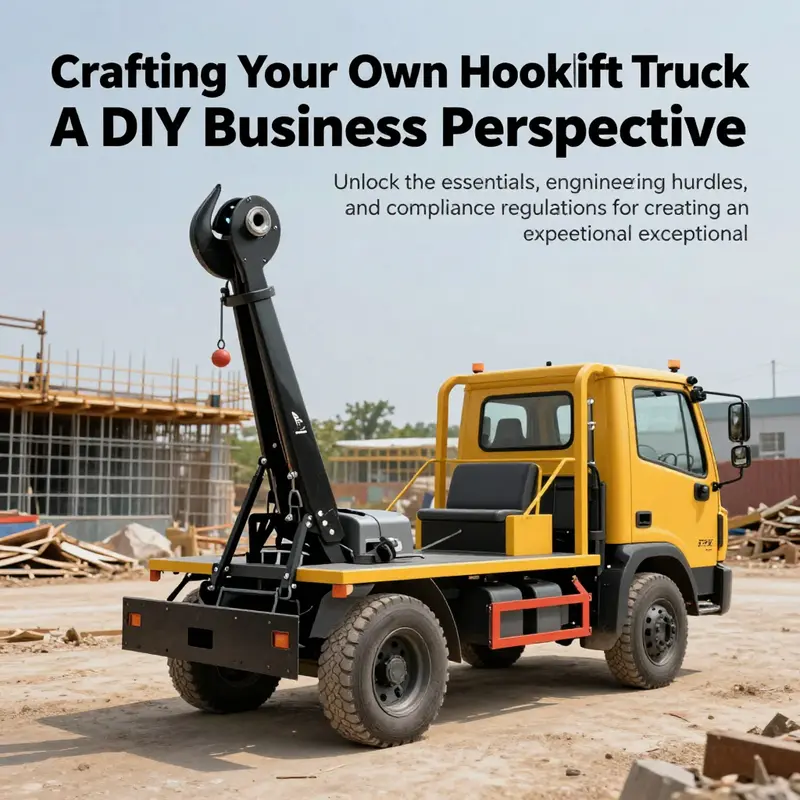
Creating a DIY hooklift truck may sound exciting, but it involves intricate knowledge of engineering, hydraulics, and regulatory compliance. As a business owner interested in this venture, understanding the foundational aspects, technical challenges, and legal considerations is crucial for a successful project. Chapter 1 delves into the basics of hooklift trucks, offering insight into their functionality and typical applications for businesses. In Chapter 2, we tackle the technical hurdles and engineering tips necessary to build a workable model. Finally, Chapter 3 will guide you through the essential legal regulations and compliance issues that must be considered before hitting the road with your creation.
Hooklift Fundamentals: What Makes a Powered Hooklift Truck Work—and What DIY Builders Must Know
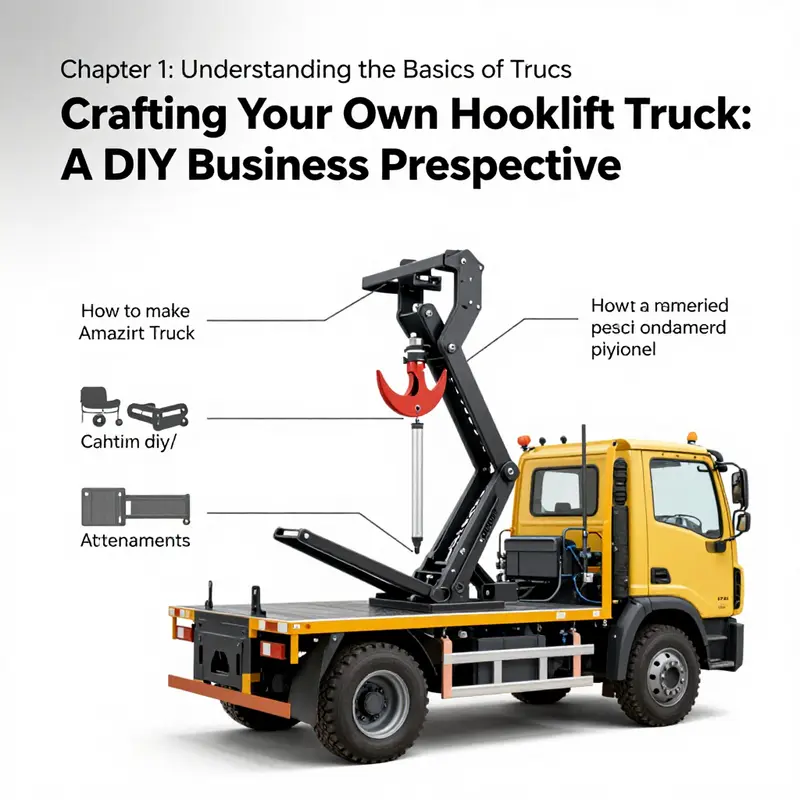
Hooklift trucks are purpose-built machines that move heavy containers quickly and safely. At first glance, they seem deceptively simple: a hook arm reaches out, grabs a container, then pulls it onto the truck bed. In reality, every movement depends on careful engineering. Structural strength, hydraulic power, load balancing, and secure attachment all work together. For anyone drawn to a “powered hooklift truck DIY” project, understanding these fundamentals is essential. This chapter explains the core mechanics, outlines the critical components, and highlights the practical and legal constraints that shape any realistic DIY route.
A hooklift’s basic function is to transfer a large, often rectangular container from ground to chassis. This single task drives the design. The hook arm must deliver strong, controlled motion. The chassis must take the concentrated loads. The hydraulic system must provide consistent force and smooth control. And the operator controls must be intuitive and fail-safe. Each of these elements carries its own vocabulary, tolerances, and safety concerns. A successful build balances them so the final system acts like an integrated machine rather than a collection of parts.
The hooklift body is the structural core. It includes the hook arm, pivot points, locking mechanisms, and the mounting structure that attaches to the truck frame. In professional units, this body is engineered as an assembly with known load ratings. For a DIY effort, the key challenge is replicating that integrity. Steel grades, weld quality, and the geometry of pivot points determine how well the system resists bending and shear. Underloads, a weak pivot or poorly sized plate can fail. That’s why builders should approach the body as a structural project first, then as a mechanical one.
Hydraulics provide the motion and the muscle. A typical powered hooklift uses a hydraulic pump driven by the truck’s engine or an auxiliary power unit. The pump supplies pressurized fluid to cylinders that extend and retract the hook arm and operate the locking mechanisms. Hydraulic hoses, fittings, and valves control the flow and direction of fluid. Pressure relief valves and accumulator systems protect components from spikes. Smooth operation requires matched components: cylinder bore and stroke, pump flow rate, and valve size must align with the desired speed and force. Oversized pumps produce jerky motion; undersized cylinders limit load capacity. For the DIY builder, sourcing hydraulic components with clear specifications is vital.
The chassis and cab are not mere carriers. They form the foundation of load distribution. A hooklift concentrates force at the truck’s rear and center. When a loaded container is pulled onto the bed, the load path travels through the hook arm, the mounting plates, and into the chassis rails. If the chassis is under-rated or the mount points are improperly located, stress will concentrate and cause cracks. Strengthening typically means welding on additional crossmembers, using plate reinforcements, and ensuring the frame rails are straight and square. Any modification must respect the original frame’s rated capacities. A mismatched configuration may pass initial tests but fail in service.
Controls and human interface shape the final usability. Operators need precise, predictable control to load and unload safely. Professional systems use proportional control valves that vary flow smoothly. Safety interlocks prevent actions when conditions are unsafe. For a DIY system, simple directional valves may suffice for a small prototype, but they offer less finesse. Implementing pilot-operated relief valves, a neutral safety switch, and indicator lights or gauges helps operators make informed decisions. Thoughtful control placement and ergonomic layout reduce risks and speed up operation.
Load calculations are where engineering meets reality. Every hooklift has a rated working load limit. That limit derives from the weakest element in the system under expected conditions. To estimate capacity, start with the container’s loaded weight and add dynamic factors such as impact during pickup. Calculate bending moments at pivot points and shear forces on mounting bolts. Use conservative safety factors. If you plan to handle a 5,000 kg container, the arm, pins, and chassis mounts must be sized to carry far more. In practice, doubling the expected load is a common conservative approach for hobby builds. Never rely solely on eyeballing or similar units unless their ratings are clearly documented.
Material selection drives longevity and safety. Hooklift bodies in commercial machines often use high-strength, low-alloy steel for its excellent toughness and weldability. For a DIY build, consider commonly available structural steels with known properties and consistent supplier certification. Avoid unknown scraps or mixed batches that may hide defects. Fasteners should be grade-rated and properly torqued. Welding must be performed by a qualified welder or under direct supervision. A poorly executed weld can be the weakest link in an otherwise sound design.
Design geometry governs leverage and stability. The hook arm acts as a lever. Its length, pivot location, and the container’s engagement point determine mechanical advantage. A longer arm reaches further but increases bending moment. A shorter arm reduces leverage and demands more cylinder force. The roll-on action of a hooklift uses the truck’s bed angle and the container’s wheels or skids to transition the load. Ensuring correct alignment between the hook tip, container anchor, and bed support points prevents binding and reduces wear.
Attachment and securement are safety-critical. A secure lock holds the container while the truck moves. Commercial designs use multiple locking points and mechanical catches that engage under load. For a DIY conversion, at least one robust mechanical lock that engages automatically is essential. Relying only on hydraulic pressure is unsafe. Hydraulic systems can leak or lose pressure. A mechanical lock retains the load even with hydraulic failure. Secondary restraints such as chains or safety latches add redundancy and are inexpensive insurance.
Testing and validation are not optional. Prototype builds require staged testing under controlled conditions. Begin with lightweight loads and slow movements. Inspect all welds, pins, and mounts after each cycle. Monitor hydraulic hoses for leaks and fittings for proper seating. Use strain gauges or simple deflection measures to gauge stress points. Pay attention to heat buildup in hydraulic components. Excessive temperature indicates mismatched flow or overwork of the system. If any element shows unexpected deformation, stop and reassess. Testing must be methodical, measured, and incremental.
Costs often shape the decision to build or buy. While a DIY approach can teach mechanical principles and yield a custom fit, the expense of quality hydraulic components and structural steel adds up quickly. Pumps, cylinders, control valves, and fittings are not inexpensive, especially when sourced new and rated for heavy-duty use. Fabrication labor, if outsourced, further raises costs. For many builders, the most economical path is to repurpose an existing hooklift body or to build a small-scale working model for demonstration and learning.
Regulatory considerations govern road use and safety compliance. Any vehicle modified to carry different loads or to operate with a new lifting system must comply with vehicle safety standards. Depending on jurisdiction, modifications may require inspection, re-registration, or certification. Weight distribution affects braking and handling, and additional safety equipment may be mandated. For DIY builders, one practical strategy is to design and test off-road prototypes or trailers that do not enter public roads. This approach allows experimentation while avoiding complex certification processes.
Alternatives to full-scale builds offer educational value without the same complexity. Scaled models, electric-actuated prototypes, or trailer-mounted hooklifts provide useful platforms for understanding the mechanisms. Electric linear actuators can simulate hydraulic cylinders for smaller models. These systems let builders explore geometry, locking mechanisms, and controls safely and at lower cost. Once a design is proven at scale, decisions about upscaling to hydraulics and heavy steel become better informed.
Safety culture matters as much as materials. Professional operations follow checklists before every lift. Visual inspection, hydraulic fluid checks, and verifying lock engagement are routine. In a DIY setting, adopt the same discipline. Create and follow checklists. Train anyone who will operate the system. Treat the machine with respect and assume that components can fail. Redundant features and clear operational protocols reduce the risk of accidents.
Maintenance extends service life and keeps performance predictable. Hydraulics need clean fluid and regular filter changes. Hoses and fittings require inspection for abrasion and leaks. Pins and bushings should be greased on a schedule. Bolts must be retorqued after initial cycles. Corrosion protection such as painting and undercoating preserves the structural parts. A maintenance log helps track these actions and reveals trends before failure occurs.
Integration with auxiliary equipment may enhance utility. Bed-mounted winches, guide rails, and wheel chocks help with load alignment. Simple mechanical aids reduce the precision required during pickup. Electrical interlocks that prevent drive-away without lock engagement add safety. These additions often come from other truck accessories and can be adapted to the hooklift environment with care.
When assessing whether to pursue a DIY powered hooklift, weigh three practical questions. First, is the goal educational or operational? A learning prototype demands different resources than a truck intended for daily commercial use. Second, are the necessary skills and equipment available? Welding, hydraulic plumbing, and structural calculation skills are essential. Third, is there a safe test environment? Controlled testing mitigates risk while revealing design shortcomings.
For builders committed to a hands-on project, begin with clear documentation. Create drawings with dimensions, material specs, and load ratings. Label each hydraulic line and control point. Plan for access to service points and for inspection windows. Record test results and iterate. Treat the build as an engineering exercise with defined milestones and acceptance criteria. This approach separates hobbyist tinkering from a repeatable, safe, and functional outcome.
Finally, use trusted references to fill gaps in knowledge. Authoritative engineering articles explain standards, mounting practices, and the mechanics behind hooklift bodies. These resources provide technical context and practical details that short videos often omit. Learning from established technical content reduces guesswork and improves safety.
For more detailed engineering guidance on hooklift bodies and standards, consult this technical overview from a reputable industry source: https://www.equipmentworld.com/2026/01/21/inside-hook-lift-truck-body-key-details-standards-and-how-to-apply-in-engineering/.
For related truck accessory information that can inform auxiliary features, consider this resource on liftgates, which covers complementary lifting solutions and safety practices: liftgates.
Chapter 2: Engineering Realities and Creative Pathways in DIY Hooklift Trucks
The appeal of a powered hooklift truck—one that can switch from a ready-to-transport chassis to a versatile lifting platform in a matter of moments—sits at the intersection of practicality and engineering bravado. For the hobbyist, maker, or small workshop, the vision promises a vehicle that can handle containers, swap bodies, and adapt to varied on-site tasks without the downtime of dedicated equipment. Yet that vision sits behind a veil of hard engineering realities. The journey from concept to a functioning vehicle, even a partially outfitted prototype, is rarely a straight line. It demands a careful balance of hydraulics and mechanics, an eye for structural integrity, and a respect for the safety and regulatory frameworks that govern on-road vehicles. Reading through the domain conversations around powered hooklift concepts, one encounters a recurring theme: the most compelling ideas are tempered by the practical constraints of materials, control systems, and the uncertain economics of fabrication at scale. This chapter explores those technical challenges not as a fearsome wall to scale but as a map of critical decision points where creativity must cooperate with physics, safety, and compliance.
At the core of any hooklift system lies a lifting mechanism that must perform under demanding loads while preserving stability and precision. The simplest way to frame the problem is to imagine the lift as an articulating pair of arms connected to a pivot that rotates around a fixed point on the vehicle frame. When a container is engaged, the system must translate a horizontal pull into a controlled vertical lift, then reverse the sequence to deposit the load. In a DIY context, engineers often weigh two broad pathways: a hydraulically powered solution and a mechanically driven alternative, perhaps using a combination of mechanical linkages, screws, or pneumatic stages. Each path presents its own set of trade-offs. Hydraulic systems, with their high force density and smooth, continuous control, are the traditional choice in professional hooklifts. They deliver substantial lifting capacity and the ability to modulate speed and force with relative finesse. The downside is the complexity: hydraulic pumps, high-pressure hoses, control valves, reservoir management, thermal considerations, and the need for rigorous leak prevention. The risk of pressure loss or hose failure during a critical lift is not merely inconvenient; it can be catastrophic for both operator safety and payload integrity.
In the DIY landscape, some builders pursue a lighter, pneumatics-assisted approach or even simplified mechanical solutions to reduce complexity. Pneumatic cylinders, while easier to source and maintain, typically offer less lifting force per unit compared to hydraulics and can introduce issues with speed control and stall during high-load scenarios. A hybrid approach—using hydraulics for the primary lift and pneumatic actuation for auxiliary functions or fine-tuning—appears in certain projects as a compromise. Regardless of the chosen path, the engine-driving decision remains central. A generator or small diesel, or even an electric drive train, must feed the hydraulic pump or mechanical system with enough power and torque while ensuring the vehicle retains maneuverability and reliability. The powertrain decision then threads into the vehicle’s overall design: weight distribution, drivetrain layout, cooling capacity, and electrical architecture all interact in a way that amplifies or diminishes the feasibility of a DIY hooklift.
Structural integrity is the second pillar of this engineering equation. Hooklift arms bear substantial bending moments as they reach out to attach and lift a container. They must resist fatigue from repeated cycles, maintain alignment across pivot points, and stay resilient under load shifts caused by irregular payloads. In professional applications, the frame and arms are engineered with finite element analysis, tested for torsional rigidity, and welded with certified procedures. In a DIY project, the challenge becomes how to approximate these rigorously evaluated properties with available tools and without the cost of a full engineering staff. Builders often gravitate toward high-strength steel sections or aluminum alloys, chosen for their strength-to-weight ratios and fatigue resistance. The weld quality then becomes not a mere technical detail but a determinant of long-term safety. Subtle misalignments at joints can propagate into bind-ups or unpredictable load paths, especially when the lift is out of balance or when a container sits unevenly on the forks or grabbing points.
The discussion of alignment, however, quickly widens into a broader conversation about the whole machine’s governance. The hooklift does not operate in a vacuum; it is part of a live system that includes the underlying truck chassis, the hydraulic harness, the control interface, and the operator’s safety belt of procedures. Achieving smooth operation across all these subsystems requires careful orchestration. Actuators, linkages, and pivot points must be machined and assembled with a level of precision that rivals early-stage automotive prototyping. Even small misalignments can cause binding, excessive wear, or dangerous swinging of the load. Precision, in this sense, is not a luxury; it is the backbone of reliable lifting performance. The challenge becomes how to integrate these components using accessible tooling. Many DIY practitioners leverage CAD modeling as a planning tool, paying attention to tolerances, mating surfaces, and the path of motion. Even without a full in-house machine shop, the digital planning stage can reveal potential interference before metal meets metal. The benefit here cannot be overstated: by simulating motion, one can anticipate collision with the truck frame, ensure that reach and stroke meet load requirements, and foresee thermal limitations before manufacturing begins.
Power and control systems weave into this narrative as another axis of complexity. The control system must translate human intent into mechanical action with predictable responsiveness. Manual levers offer direct feel and simplicity, while electronic controls promise repeatability, programmable speed, and safety interlocks. The choice often hinges on the operator’s skill set and the intended use of the vehicle. A purely manual system might excel in rugged field environments where electronics are prone to dust and moisture, but it can demand more effort and response time from the operator. Conversely, an electronic or semi-automatic control system can deliver fine control and feedback, but it introduces a layer of software and electronics that must be protected from the harsh realities of a worksite: heat, dust, vibrations, and moisture. In either case, sensors become our allies. Load sensors can provide feedback on weight distribution and container load, enabling the system to adjust motor speed or hydraulic pressure to maintain stability. Position sensors can ensure that the lifting arms converge on their target with consistent alignment. Yet sensors must be paired with a robust fail-safe strategy. Overload protection, emergency stop functions, and mechanical stops are not optional features; they are essential safeguards that prevent the worst-case scenarios from becoming reality. The interplay of control logic, sensor input, and mechanical output forms a feedback loop whose stability is critical to user safety and equipment longevity.
Thermal management follows as a practical, sometimes overlooked, dimension. The continuous operation of a hydraulic pump, motor, or valve bank generates heat. If heat is allowed to accumulate, seals degrade, hydraulic fluid viscosity shifts, and performance deteriorates. In a DIY project, where cooling paths may be constrained by the chassis geometry and the absence of industrial radiators, creators must design with pragmatism. Passive cooling through adequately spaced venting, heat sinks for electrical components, and, where possible, dynamic cooling strategies become the order of the day. Thermal issues do not exist in a vacuum; they influence system efficiency, control accuracy, and the safe operating envelope of the lift. The naive assumption that “more power equals more capability” invites a heavy cost in heat management and system wear. The most robust DIY concepts acknowledge this reality and embed thermal considerations early in the design, rather than as an afterthought.
Beyond the raw physics of lifting and holding lies a world of practical experimentation and iterative refinement. The DIY community often discovers that the most valuable insight comes from reusing proven concepts rather than reinventing every wheel from scratch. For instance, some builders repurpose components from old forklifts or agricultural equipment to leverage established reliability and known failure modes. This approach brings a type of tacit knowledge that is usually locked behind professional service manuals and mass production quality control, but in a DIY environment, it becomes a learning platform. The act of repurposing is not merely cost-saving; it is an opportunity to study how robust rigging, clutch mechanisms, and hydraulic branch circuits were originally engineered to survive demanding conditions. It also highlights the limits of improvisation. A lift system that works on a bench might perform poorly under the vibrations of a moving truck, the dynamic loads of an uneven container, or the thermal cycles of a full workday. Recognizing these limits is as valuable as the idea that sparked the build. The difference between a clever concept and a dependable system often lies in the discipline of testing, validation, and incremental upgrades.
In that spirit of measured progression, several engineering approaches have gained traction in the DIY space that deserve attention. One recurring thread is modularity. Builders increasingly favor modular lifting assemblies that can be tested in isolation before integration with the truck. A modular plan makes it possible to swap actuators, sensors, and control cards with relative ease, enabling experimentation without risking the whole machine. It also makes the project more scalable: once a basic, safe lifting function is proven, the same architecture can be extended to handle different container geometries or even different loads. Another thread emphasizes accessibility of parts. A number of builders use off-the-shelf hydraulic or pneumatic cylinders with standardized mounting patterns, selecting fit-for-purpose rods and seals that maximize life under worksite conditions. The aim is to achieve predictable behavior with components that are readily available, reducing downtime and maintenance headaches. For many, the middle ground lies in using microcontrollers and compact control modules to implement a simple feedback regime. An Arduino or a similar platform, connected to a few sensors and actuators, can deliver a compact, learnable system that demonstrates lift, hold, and lower cycles within a safe envelope. This approach encourages learning and iteration while avoiding the complexity and risk of a fully autonomous, weaponized control system.
An important dimension of the discussion is the economics of DIY hooklift projects. It is tempting to view the hooklift as a single performance metric—the maximum rated load or the speed of cycle times. In reality, the economics of a DIY hooklift revolve around total cost of ownership, including materials, fabrication time, safety compliance measures, and the long-term maintenance burden. Material choices affect not only strength and weight but corrosion resistance and lifecycle costs. Welding procedures and quality control add labor costs that can dwarf the price of raw steel if not managed efficiently. The cost of hydraulic plumbing, seals, and reservoirs tends to escalate quickly as the system grows more capable. Moreover, even if a home workshop can assemble a functional lift, the question of compliance with local vehicle safety standards remains. Roadworthiness is not a mere afterthought; it determines whether the vehicle can legally operate on public roads, which in turn defines the scale of the project’s applicability. Those realities often lead builders to pursue hybrid strategies: building a safe, well-documented prototype for private testing, while leaning on commercially manufactured lift platforms or chassis-mounted sub-assemblies for regulated on-road use. The pragmatic conclusion is clear: a DIY hooklift project is as much about risk management and governance as it is about mechanical ingenuity. The more transparent and conservative the approach to safety and compliance, the higher the likelihood that the work will translate into tangible benefits for users and operators.
In the horizon of engineering ideas, there is room for creative experimentation without compromising safety. Some builders explore repurposing elements from other machinery to create novel solutions that still respect the physics of lifting. For instance, the idea of using a compact, high-speed hydraulic circuit for rapid conformance of a light container in a controlled work area, combined with a stout mechanical frame for the heavier loads, can produce a system that performs well within a narrow scope. The combination of precise motion control and robust mechanical support allows the operator to interface with a load in a predictable way, reducing the risk of load shift or sudden swings that could pose hazards on an uneven surface. In such experiments, documentation is critical. Recording design decisions, load tests, and observed outcomes provides a living knowledge base for others who might want to adopt a similar approach. This practice not only helps avoid repeating mistakes but also contributes to a broader culture of safety and accountability within the DIY community.
What emerges from these reflections is a composite view of the engineering realities behind powered hooklift trucks. The dream of a versatile, affordable, DIY lifting vehicle is tempered by the need for reliable actuation, precise geometry, and robust safety systems. It is not enough to create a mechanism that merely lifts a payload; the entire system must behave as a coherent, stable, and legal vehicle on the road. Achieving that requires deliberate engineering choices, careful material selection, and an orderly approach to testing and validation. It also invites a broader dialogue about how DIY builders can access knowledge responsibly and how the communities around DIY vehicle projects can share insights without encouraging unsafe experimentation. This is where the practical and the aspirational meet: the practical demands of structure, hydraulics, control, and safety converge with the aspirational impulse to build something that is more than the sum of its parts.
In closing this survey of technical challenges and engineering ideas, the central takeaway is provisional yet actionable. Start with a clearly defined scope of lifting capability and container geometry, and then map that scope against the structural layout of your chassis. From there, choose a power and actuation strategy that aligns with your expected duty cycle, while ensuring that all safety interlocks, load sensing, and emergency procedures are baked into the design. Embrace modularity so you can test subsystems in isolation, and be prepared for iterative refinements as you translate theoretical models into physical components. Finally, acknowledge that the most mature DIY hooklift projects often emerge not from a rush to produce a finished system but from disciplined exploration, careful documentation, and a willingness to consult established standards and practices. For readers who want to see how these concepts translate into real-world design discussions, the topic of lift mechanisms and their safety considerations is a recurring theme across many DIY vehicle blogs, where practical insights and tested approaches often find a home in a community of like-minded builders. For those seeking a concrete, practical touchstone in this area, you can consult resources dedicated to liftgates and lifting assemblies, which offer a curated view of actuation arrangements, mounting strategies, and safe handling of loads; see the linked resource here: liftgates.
As the discourse expands, it is helpful to anchor the broader exploration to a respected body of professional knowledge. In this regard, the American Society of Mechanical Engineers (ASME) provides a gateway to standards and educational materials that illuminate the technical challenges inherent in any DIY vehicle project, including the safe integration of hydraulic systems, powertrain considerations, and structural design. While the DIY journey invites experimentation, aligning with professional guidance can elevate safety, reliability, and compliance. A comprehensive overview of the technical challenges in DIY vehicle engineering is available at the ASME resource linked here for readers who want to deepen their understanding of the governing principles and the boundaries of feasible experimentation: https://www.asme.org/topics-resources/content/technical-challenges-in-diy-vehicle-engineering.
Chapter 3: Legal and Compliance Realities of DIY Hooklift Trucks
Hooklift technology combines hydraulic actuation with a modular chassis to move containers. This chapter surveys the regulatory landscape that governs heavy-duty vehicles, with emphasis on safety standards, certification, and liability. DIY or heavily modified hooklift vehicles are typically restricted from public-road use and may be illegal without certification and licensed manufacture. The text explains how regulatory bodies require compliance of structural integrity, hydraulic safety, control interlocks, and load testing, and how roadworthiness assessments, emissions, and insurance considerations shape what is permissible. It discusses common regulatory pathways that enable legitimate work, such as purchasing certified trucks, using conversion programs within a licensed framework, or performing demonstrations on private property under control. It also cautions readers about the risks of non-compliance, including penalties, loss of insurance, and civil or criminal liability. The goal is to balance curiosity with safety by encouraging learning through simulation, scale models, and component-level testing rather than building a road-legal vehicle without proper approvals.
Final thoughts
A DIY hooklift truck project presents unique opportunities for innovation and entrepreneurial growth within the waste management and construction sectors. However, success hinges on a deep understanding of the mechanics involved, the engineering challenges ahead, and the legal frameworks that must be adhered to. By leveraging the insights shared in this guide, business owners can make informed decisions and potentially unlock new revenue streams as they dive into the exciting world of custom truck builds.