

As the electric vehicle market expands, the Tesla Cybertruck stands out not just for its unique design but also for its diverse pricing options that cater to various business needs. Understanding the cost implications of different Cybertruck models is crucial for entrepreneurs considering this innovative vehicle for their operations. In this exploration, we will delve into the entry-level pricing, examine the costs associated with top-tier models, and provide historical context to illustrate how Tesla’s pricing has evolved over time. This comprehensive overview will help business owners make informed decisions when contemplating the purchase of a Tesla Cybertruck.
What the $59,990 Entry-Level Cybertruck Really Buys You: Specs, Trade-Offs, and Who It’s For

Entry-Level Pricing and What It Means
When the revised entry-level price for the Cybertruck landed at $59,990, it did more than reset the headline number. It reframed the vehicle’s positioning in a market increasingly crowded with electric pickups. That price places the truck below the psychologically important $60,000 mark for the first time since launch, but it also reflects a deliberate product trade-off engineered to hit a specific audience: people who need a rugged, practical work vehicle with the benefits of electric propulsion, not a fully loaded lifestyle pickup aimed at early adopters or luxury shoppers.
The mechanical basics behind the new price are straightforward and measurable. This version uses a dual-motor all-wheel drive layout delivering an EPA-estimated range of around 325 miles. It sprints from 0 to 60 mph in roughly 4.1 seconds and can tow up to 7,500 pounds. Those figures read well on spec sheets: the range is enough for long workdays and weekend trips, the acceleration is quick enough to be genuinely useful on highway merges, and the towing capacity suits many contractor trailers and small equipment hauls. The truck’s stainless steel shell, bullet-resistant exterior concept, and the 800V high-voltage platform remain as defining technical statements: they tell buyers the vehicle is built on a durable, high-efficiency electrical architecture rather than being a dressed-up roadster or luxury sport truck.
But the price cut to land at $59,990 was not achieved by magic. It required conscious simplification of the cabin and some dampening of premium features. The new base model retains the air suspension system in specification, but the damping settings and suspension hardware are less sophisticated than those offered on higher trims. Interior materials are functional rather than lavish: cloth seating replaces premium leather or ventilated leather, and the audio and infotainment packages are more basic. Other comfort features that once appeared on higher-level configurations were omitted or de-contented. Still, useful work-facing upgrades stayed in place: an electric roll-up tailgate eases loading and unloading in a working environment, and a bed power outlet turns the cargo area into a mobile power source for tools. Those decisions reveal the intent: keep practical utility and durability while shedding bells and whistles that push buyers into a more premium price bracket.
This repositioned base model directly targets a different buyer profile than the earliest marketing did. Early demand centered on tech-savvy enthusiasts and buyers attracted by novelty and headline performance. With the new pricing and specification mix, the truck now speaks more directly to contractors, landscapers, farmers, and small-business owners who need payload and tow capacity, plus the low operating costs of electrification. At a glance, the spec sheet aligns with that use case: range sufficient for a day of work with on-site charging available at home or depots, a bed that accommodates tools and materials, and a power outlet that runs electric jobsite equipment.
Bringing the price below $60,000 also shifts competitive dynamics. Electric pickup buyers now see an option that is closer in price to some mid-range conventional pickups, especially when tax incentives or lower operating costs are factored in. Industry analysts have noted this move as part of a broader strategy to broaden market appeal beyond early adopters. Demand for EV pickups has softened relative to initial forecasts, and competition is increasing from legacy truck brands and new entrants. A more pragmatic base price helps retain and grow the addressable market.
Understanding the trade-offs is key for any buyer who sees the number and immediately wants one. The vehicle’s signature stainless steel body and robust build remain, and the powertrain delivers the performance many buyers expect. But you should accept that the base configuration is a utilitarian interpretation of the truck concept. Interior materials and creature comforts are pared back. Suspension tuning is functional rather than plush. The audio and infotainment stack is serviceable, not immersive. These changes reduce cost without compromising the truck’s core identity as a high-capacity, long-range electric utility vehicle.
Price history is also informative. When the truck was first shown in late 2019, entry-level projections were much lower on paper. That original projection reflected a mix of aspirational pricing and optimistic assumptions about production costs and economies of scale. Between 2019 and 2026, inflation, supply-chain dynamics, raw material pricing, and the complexity of high-strength stainless-steel body construction all pushed realistic pricing upward. The new $59,990 entry price reconciles the original ambition with market reality while still positioning the product as a mainstream working vehicle.
Beyond raw specs and materials, the real-world value of this entry-level offering will come down to running economics. Electric pickups benefit from lower energy and maintenance costs over time when compared with internal combustion alternatives. Regenerative braking, fewer moving parts, and generally simpler maintenance routines reduce lifetime service demands. For businesses that can centralize charging or that charge at home overnight, the lower per-mile energy cost adds up quickly for high-mileage users. When evaluating the $59,990 figure, buyers should include projected fuel savings, lower maintenance costs, and available local or federal incentives. Those factors can substantially reduce the effective acquisition cost over a vehicle’s useful life.
That said, the up-front price still matters for many buyers. A mid-60k price ceiling gets the truck into reach of buyers who had been priced out of early, high-spec models. The value proposition becomes especially attractive for fleet purchasers who buy multiple units and can negotiate volume deals, or for small businesses that can leverage tax incentives and operational savings. For single buyers without access to such incentives, the initial outlay will still be a careful choice between the immediate benefits of electrification and the near-term cash flow impact.
From a configurability standpoint, Tesla’s approach of creating distinct trim tiers remains. The entry dual-motor model sits below a middle-tier dual-motor performance-oriented variant and a top-tier “Beast” configuration. The mid-level option balances more comfort features with similar powertrain architecture, while the top-tier version pushes towing and performance limits further and reintroduces premium materials and tech. The price spread between the base and top trims today spans roughly $40,000. That spread gives buyers clear decisions about how much they value performance, towing, and comfort features. The current “Beast” price was reduced alongside the base price, creating more incentive to step up if buyers want maximum capability.
Practical buyers will also consider how the truck adapts to aftermarket needs. The entry-level emphasis on utility leaves plenty of room for functional upgrades. Bed toolboxes, ladder racks, and adjustable roof-rail systems can tailor the vehicle for specific work demands. For those who want to outfit the truck for construction or trades, options such as modular roof racks and ladder frames can expand cargo-carrying versatility while keeping payload balanced. If you plan to add such gear, consider the trade-off between out-of-the-factory simplicity and the incremental cost of aftermarket solutions. One useful resource with ideas for adding utility hardware is a review of modular roof racks for this truck, which explores practical mounting frames and ladder solutions tailored to its unique body geometry: Cybertruck modular utility roof rack frame.
Real-world ownership will highlight another important factor: charging logistics. The 325-mile EPA estimate is generous for most daily use, but work routines with heavy towing or continuous tool use will reduce range. Fleet managers and business owners should plan charging strategies to align with shift patterns, depot infrastructure, or public fast-charging access. The vehicle’s 800V architecture enables faster charging rates on compatible fast chargers, reducing downtime. Still, in many rural or remote work settings, charging infrastructure may lag behind, so planning is critical.
Resale expectations also play a role in the value proposition. Electric vehicle depreciation patterns have been evolving, and pickup trucks historically hold value well. The fusion of truck utility and electric powertrain makes depreciation difficult to predict. If EV demand stabilizes or grows, and if battery longevity expectations remain positive, residuals could be strong. Conversely, rapid improvements in battery density and charging speeds could accelerate obsolescence for earlier models. Buyers thinking about resale should weigh how long they intend to keep the vehicle and how quickly they expect EV tech to advance.
Accessibility and timing are practical considerations too. After the price update, the base model became orderable on the manufacturer’s U.S. website, with deliveries slated to start in the months that followed. Availability in international markets remains unclear; localized regulations, homologation, and region-specific charging standards will influence rollout timing. Early purchasers in regions outside the initial market should expect staggered delivery phases.
Finally, the psychological impact of a sub-$60,000 entry price should not be underestimated. It sends a signal that electric pickups are shifting from niche novelty to mainstream utility. Price alone does not create mass-market adoption, but it removes a major barrier for a crucial segment: the buyer who needs a reliable work vehicle and is open to electric technology if it proves cost-effective. That buyer will look beyond sleek displays and headline acceleration figures. They will ask whether the truck can handle jobsite demands, how it performs when fully loaded, and whether the cost of ownership makes sense for their business.
The $59,990 entry price therefore reframes the conversation. This version is not a stripped show truck; it is a purposeful tool built for everyday work. It keeps the structural and electrical hallmarks that define the model but trims the interior frills to deliver a price that invites a new set of buyers. For those who prioritize utility, towing, and the long-term benefits of electrification, it offers a compelling package. For luxury-minded buyers, the higher trims remain available. Either way, the new price makes it easier for businesses and practical buyers to evaluate the electric pickup not as a statement, but as a capital purchase that should earn its keep.
External source for official specs and current pricing: https://www.tesla.com/cybertruck/specs
What the Top Price Means: Decoding the Cyberbeast and High-End Cybertruck Costs

Understanding the new top-tier price and what it buys
The top-tier variant of this electric pickup line carries a singular role. It signals what the maker can do when there are no budget constraints. The model known as the Cyberbeast now lists at $99,990 in the U.S. market after a recent reduction. That move changes how prospective buyers, dealers, and competitors view the brand’s pricing ladder. It also reshapes the value proposition for those weighing premium capability against everyday practicality.
At a glance, the headline is simple. The Cyberbeast’s prior sticker sat near $115,000. The lowered price, about $100,000, makes the package more accessible to buyers who seek extreme performance in a pickup. But dollars alone tell only part of the story. Understanding this model’s pricing requires looking at what differentiates it from cheaper variants, why the manufacturer adjusted the price, and how that change affects ownership calculus.
This vehicle sits at the intersection of several trends. Electric vehicle technology has matured, components have become more available, and production learnings have trimmed costs. At the same time, the market for electric pickups has heated up, bringing new competitive pressure. The new top-tier price can be read as a response to these forces. It is an attempt to preserve the vehicle’s halo status, while making the badge less exclusive.
What the premium actually buys
Paying for the top-tier variant means paying for concentrated capability. The Cyberbeast bundles higher output, enhanced torque, and advanced driving features. It often includes heavier-duty drivetrain components designed to handle extreme loads. The package targets buyers who need or want maximum towing, acceleration, and ruggedized hardware. That includes modified suspension, reinforced structural elements, and specialized software tuning for off-road or hauling scenarios.
Beyond raw power, the premium price reflects additional materials and bespoke calibrations. Higher-grade brakes, reinforced motor mounts, and beefed-up cooling systems help maintain performance under stress. Interior appointments may be more robust or sport-oriented. Exterior touches, like protective skid plates and unique finish options, add perceived exclusivity. Buyers at this tier often accept a higher price for the confidence these components provide.
Still, there are trade-offs. The costlier trim does not always include every comfort or convenience feature available across the lineup. Occasionally, engineering choices prioritize performance over luxury. In other words, the most expensive model is not simply a fully optioned version of the base truck. It is a purpose-built variant with focused enhancements.
Why the manufacturer reduced the sticker price
The decision to reduce the top-tier sticker is strategic. Price cuts rarely come from one cause. They are usually a blend of market feedback, inventory realities, and broader company strategy.
One major factor is the need to stimulate demand. When an expensive model sits unsold, reducing its price can jump-start buyer interest. A lower sticker broadens the competitive landscape, drawing in buyers who might previously have dismissed the vehicle as too pricey.
Another factor is production efficiency. As manufacturing processes improve, component costs fall. The maker may pass some savings to buyers, especially if doing so supports higher volume and scale. This is particularly true for electric trucks, where spreading fixed costs over more units improves margins.
Competitive pressure also plays a role. New rivals and alternative premium trucks have entered the market. To maintain a leadership position, the company must reconcile its high-performance ambitions with realistic price points.
Finally, marketing and brand considerations matter. Reducing the top price can refresh interest and create new headlines. That publicity often drives traffic to showrooms and configurators, indirectly boosting sales for other trims as well.
How this reshapes the lineup
When the top-tier price drops, it affects buyer psychology for the entire lineup. The new $99,990 price creates a tighter spread between base and premium units. The entry-level all-wheel-drive variant now starts at $59,990. That gap frames the premium as a higher but more justifiable step rather than an unreachable leap.
A narrower price gap can encourage buyers to trade up. For customers considering the mid-tier model, the incremental cost to reach the top-tier looks smaller. This effect often raises the average transaction price.
At the same time, the company may have simplified options to protect margins. In earlier versions, certain luxury features like air suspension, ventilated seats, or premium audio might have been standard on higher trims. To hit a new sticker target, some of these items could be removed or bundled differently. Buyers should scrutinize standard versus optional equipment. The visual impression of a fully loaded truck might hide feature changes that matter to daily comfort or convenience.
Total cost of ownership considerations
Price is only the entry point. Total ownership costs include charging, maintenance, insurance, depreciation, and potential upgrades. High-performance variants can increase some of these costs. Insurance premiums may rise due to higher repair costs and more powerful drivetrains. Tires and brakes on beefed-up models wear faster under spirited driving. Yet electric drivetrains generally lower routine maintenance costs compared to combustion alternatives.
Another angle is energy consumption. Larger motors and performance-oriented setups can consume more kilowatt-hours under heavy loads. Owners who frequently tow or travel at high speeds may see a meaningful difference in real-world range. That may increase charging frequency and electricity costs.
Depreciation patterns are also relevant. The higher the initial price, the more critical it is to assess how the market will value the truck used. A top-tier model could retain value better if its capabilities remain unique. Conversely, if competing models match its performance at lower prices, resale could suffer.
Financing and fleet purchase dynamics
Financing options shape affordability. Lenders evaluate residual values and demand. A price cut can improve residual value projections by boosting demand. That, in turn, improves loan terms. Lease deals may also look better when the buyout gap narrows.
Large buyers and fleets also react to top-tier pricing. A lower premium might make the advanced variant appealing to specialized fleets. Emergency services, utility companies, and commercial operators may value the added capability. Yet they weigh higher acquisition costs against lifecycle benefits like reduced fuel and maintenance.
For some fleet buyers, the price shift could unlock new use cases. A fleet that once ordered only base units might now select a fraction of high-capability models for tasks requiring extra power. That mixed-fleet approach can optimize operational costs while covering diverse needs.
Customization and aftermarket choices
Owners who want premium capability without the top-tier sticker often pursue aftermarket upgrades. Reinforced suspension kits, heavy-duty brakes, and performance tuning are common routes. Yet retrofitting carries its own costs and risks. Warranty coverage may be affected. Official top-tier models often come with factory integration and calibration that aftermarket parts cannot replicate.
Additionally, accessory options can change the ownership story. Roof racks, storage solutions, and cargo accessories alter how practical the truck becomes for daily tasks. For those interested in upgrading functionality, consider factory packages before buying aftermarket parts. A readily available resource outlining modular roof solutions is the Cybertruck modular utility roof rack frame. That guide explains one practical route to increase cargo capacity and versatility.
Perceived value versus practical value
Buying the top-tier model often reflects an emotional decision. The status of owning the flagship, the thrill of maximum acceleration, and the idea of having the best available hardware all matter. These intangible benefits influence many buyers.
However, the practical value depends on use. If towing heavy loads regularly, the top-tier capabilities justify the cost. If the truck mainly serves urban commuting, the premium may be harder to justify. Buyers should match the specification to their needs rather than aspirational ideals alone.
When the premium makes sense
The top-tier model shines in scenarios that demand its strengths. Frequent towing of heavy trailers, intensive off-road use, and applications requiring sustained high-power output are typical examples. Pros who use the vehicle as a workhorse may find the higher initial cost repaid through capability and downtime reduction.
For enthusiasts, the performance credentials are compelling. The unique engineering in a flagship variant often produces a level of responsiveness and handling absent in lower trims. If that thrill is central to ownership, the price becomes part of the desired experience.
When to consider alternatives
If daily use is mild, most buyers will see diminishing returns on premium hardware. Middle trims often cover the majority of needs at a fraction of the cost. Buyers can also manage performance through software or modular upgrades later.
Prospective buyers should also consider upcoming market offerings. Electric pickup competition is intensifying. New launches could deliver similar performance at lower price points. Patience, research, and careful timing can guard against overpaying for features that soon become mainstream.
How dealers and secondary markets will react
Official price reductions change dealer behavior. Dealers may adjust ordering patterns, preferring a mix of trims that aligns with demand projections. Dealers sometimes use price shifts to negotiate more effectively or to promote specific inventory moves.
In the secondary market, a reduced new-car price can depress used values for older premium examples. That effect happens when there is a close substitute available new at a lower price. Conversely, unique configurations or limited editions may hold value despite the drop.
Practical buying advice
Start by defining real needs. List towing, cargo, and daily driving requirements. Next, compare those needs to the standard equipment of each trim. Confirm which features are standard and which are optional.
Take test drives under varied conditions. Performance under load and behavior at highway speeds often reveal trade-offs invisible in showroom specs. Pay attention to ride quality, cabin noise, and driver aids.
Estimate operating costs, including charging patterns and insurance. Speak to owners in relevant forums and communities. Real-world accounts often highlight issues not obvious on paper.
If customization is likely, check factory compatibility and warranty terms. Some factory options better integrate with vehicle systems than aftermarket parts.
Make the purchase decision with total cost in mind. Factor in depreciation, likely resale timing, and potential incentives. For those financing, run scenarios with different residual assumptions.
Strategic implications for the brand and buyers
The price cut to $99,990 does more than shift the market; it signals intent. It shows the maker wants this variant to sell at scale. For buyers, that translates to better support, more aftermarket interest, and wider community knowledge.
At the same time, lowering the top price lifts expectations across the industry. Competitors will respond, directly or indirectly. Buyers should expect continued refinement of offerings, both in feature sets and in price.
Final perspective
A flagship truck priced at roughly $100,000 occupies a distinct niche. It serves buyers who need uncompromised capability or who value the status of top performance. The recent price adjustment makes that niche larger. It reduces the premium gap but preserves the model’s unique engineering focus.
Ultimately, the decision to buy a top-tier model rests on aligning real-world needs with the vehicle’s strengths. The new sticker price changes the calculus, but it does not change the practical considerations. Scrutinize standard equipment. Compare operating costs. Evaluate how much of the premium is emotional value versus practical utility.
For those who already decided they want the top-tier capability, the reduced sticker is welcome. For those still weighing options, the price cut may push the vehicle into contention. Either way, understanding the details behind the price is essential.
For the latest official pricing and model details, visit the manufacturer’s pricing page: https://www.tesla.com/cybertruck
From Reveal to Road: The Cybertruck’s Price Journey and What Drove Each Shift
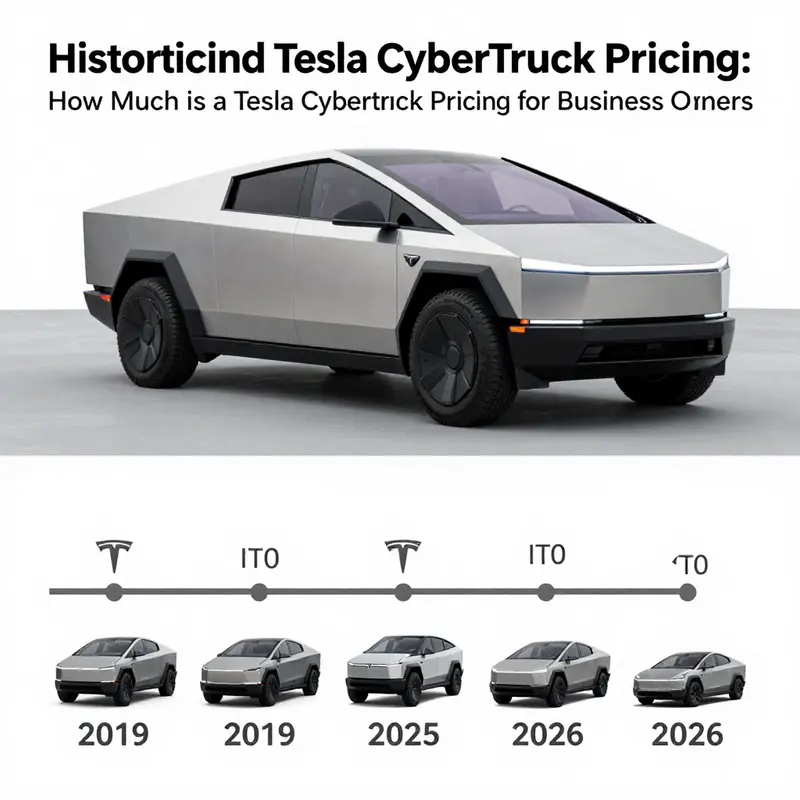
When the vehicle was first revealed, the price tag attached to it felt like a bold promise. That initial figure carved an expectation into the market and into buyer minds. Over time, the number moved for reasons both mundane and structural — delays, new manufacturing needs, shifting model mixes, and strategic trimming of features. This chapter traces that journey. It connects the headline prices with the production realities behind them, and it explains how the current range emerged from earlier targets and market tests.
At the unveiling, leadership announced an aspirational starting price of roughly fifty thousand dollars. That announcement served two purposes: it positioned the vehicle as an attainable electric pickup, and it created a dramatic contrast with more expensive premium trucks. Yet, the announced number was never a fixed promise; it was a target shaped by optimistic assumptions about supply chains, component costs, and manufacturing learning curves. When production did not follow the desired timeline, the cost picture hardened. Delays added expense. New tooling, specialized processes, and the need to scale unusual materials raised the per-unit cost above that early estimate.
By the time the first units reached customers, the available starting configuration differed from the initial target. A single-motor, rear-wheel-drive variant arrived with a higher sticker. That model reflected a compromise between cost control and market signaling. On one hand, it allowed a lower base to exist in the lineup. On the other, it revealed the real cost of producing a vehicle with a distinctive structural shell and nonstandard construction methods. Materials like the stainless-steel body required special handling and novel assembly techniques. Those manufacturing peculiarities pushed baseline costs up compared with more conventional designs.
Within a few months after initial deliveries, additional powertrain options and trim levels expanded the pricing map. A dual-motor all-wheel-drive option and a tri-motor high-performance option joined the lineup. Each addition raised the price by significant increments. These were not arbitrary jumps. The AWD system demanded additional motors, larger battery capacities, and more complex thermal and control systems. The high-performance variant required even more powertrain robustness and suspension tuning. Tesla, having experimented with tiered offerings in other model families, used the same strategy here: offer a wider set of choices to capture buyers at different performance and budget points. That naturally broadened the price range.
Along the way, market feedback altered the configuration mix. Some lower-cost variants showed weak demand. Buyers who wanted the vehicle tended to value performance and capability, not just the lowest possible price. As a result, one of the earliest base variants that underperformed in sales was phased out. The company replaced it with a different baseline: a dual-motor all-wheel-drive model that balanced cost, capability, and demand. To reach a more attractive entry price, the engineering team selectively removed higher-cost comfort features. Air suspension, ventilated seats, and premium audio, for example, were among the items trimmed from the lowest-priced configuration. Those trade-offs lowered the cost while preserving the vehicle’s core strengths: durability and utility.
Beyond product choices, broader economic forces shaped price adjustments. Raw material costs fluctuated. Steel and battery component prices changed in response to global demand. Supply chain disruptions, evident during multiple waves of reduced capacity and transport bottlenecks, increased lead times and sometimes forced purchases at premium rates. Those pressures pushed costs into the retail price. Currency shifts and regional tariffs affected specific markets, creating regional price variance. Tax incentives and rebates in different jurisdictions sometimes offset those increases for final buyers, but manufacturers still had to price for global realities.
Another important influence came from production scaling and manufacturing learning curves. Initially, when output was constrained, per-vehicle fixed costs were high. As production volumes increased, some efficiencies emerged. Automation improved, assembly processes became smoother, and yield losses fell. Those gains enabled strategic price adjustments over time. In some cases, higher-volume production allowed the company to lower prices on certain trims, or to reposition features across models. Yet even with these efficiency gains, the cost base never dropped to the earliest optimistic targets. Specialized materials and a unique structural design maintained a price premium relative to more conventional trucks.
Market positioning also colored pricing decisions. Leadership made clear that this vehicle sat between utilitarian work truck and tech-forward lifestyle pickup. That dual identity justified a price that was higher than the most basic commercial trucks, but often lower than the most luxurious legacy pickups with comparable performance. Pricing reflected a desire to be credible as a utilitarian tool while offering a technology edge. That balancing act meant the company kept several mid- and high-tier trims to appeal to buyers seeking performance or premium comfort.
A notable episode in the pricing timeline came with an explicit reduction for the top-tier model. Originally priced well into five figures higher than the entry trim, the performance-focused edition later received a lower sticker. That reduction achieved multiple goals. It broadened the addressable market for the highest-performance variant. It responded to market signals about price elasticity at the top of the lineup. And it set a new reference point for what buyers could expect when choosing the most capable configuration. The lower top-tier price made high performance relatively more accessible.
Conversely, entry price changes reflected both market dynamics and internal strategy. When the company shifted the bottom trim to a different configuration, it did so to improve sales and simplify manufacturing. Replacing an underperforming rear-wheel-drive base with a dual-motor all-wheel-drive entry helped rationalize the production mix. It also matched what buyers were choosing, reducing complexity in the supply chain. To achieve the new, lower entry price point, engineers removed several premium comfort items. That stripped-down entry model still delivered the truck’s essential value propositions: robust exterior, substantial towing and payload capability, and advanced driver assistance features. Buyers wanting a more plush experience could opt into higher trims.
Throughout the period, the company offered and adjusted financing options and incentives. Those moves sometimes masked the underlying sticker price from consumers who focused on monthly payments or lease figures. At times, introductory promotions or limited-time credits made the vehicle feel more affordable, while permanent feature-based price adjustments represented structural shifts in costs. Buyers who tracked cash price changes saw the real trajectory: initial optimism, a higher early sticker after production realities arrived, then a gradual recalibration through model repricing and trim reshuffles.
The secondary market also signaled how the public valued the vehicle. Early adopters who took delivery at higher prices influenced resale values. In some regions, scarcity and strong demand sustained robust resale prices, while in others, where supply caught up, resale softened. Those aftermarket trends fed back into perception. When resale remained strong, some buyers felt the higher initial price was justified. When the secondary market cooled, pressure mounted to make entry points more attractive.
Two technical details deserve attention for their pricing impact. First, the body and exterior construction relied on unusual materials and processes. Those choices increased the machine and tooling cost. Second, the battery and powertrain options represented a large portion of the vehicle price. Battery chemistry, pack size, and motor count directly translated into tens of thousands of dollars in parts cost. As the company optimized procurement and incremental improvements in cell cost arrived, some of that savings could be passed along in price adjustments. But not all savings translated directly to lower retail prices. Strategic decisions sometimes redirected savings into margin or into funding lower prices on specific trims.
Beyond the vehicle itself, accessories and aftermarket options shaped the effective cost for many buyers. Owners who sought to add racks, toolboxes, or specialized storage found third-party suppliers offering tailored solutions. Those add-ons could significantly increase a buyer’s final outlay. For readers exploring practical accessories, an informative source on aftermarket options for the platform is the Cybertruck Co feature page, which catalogs modular gear and rack solutions. That resource highlights how equipment choices can sway a buyer’s total spend, separate from the vehicle’s base price.
By early 2026 the lineup and pricing had settled into a recognizable pattern. The entry configuration, now a dual-motor all-wheel-drive model, carried a starting price just under sixty thousand dollars. That trim intentionally omitted some premium comforts to hit the sub‑sixty thousand mark. At the top end, the performance-focused model priced just under one hundred thousand dollars after a deliberate reduction from an earlier higher price. These numbers reflected both a maturing manufacturing process and deliberate strategic choices. The mid-range trims remained positioned to offer better comfort or capability, at price points that bridged the entry and performance models.
Regional differences still mattered. Dealers and company channels adjusted for local taxes, import duties, and incentive programs. In markets with generous electric vehicle incentives, effective consumer prices could be substantially lower. In regions with higher tariffs or weaker incentive frameworks, out-the-door cost rose. Exchange rates and local regulatory requirements also added variability. Prospective buyers were therefore advised to consult local pricing pages or authorized sellers for precise figures.
The price journey also offers lessons about setting expectations for future vehicle launches. Manufacturers that announce aggressive introductory prices must account for the entire set of challenges between sketch and production. Material choices, supply chain interruptions, and engineering surprises can all push costs upward. Likewise, once a vehicle is in production, the balance between trimming features and preserving perceived value becomes critical. Removing comfort features can lower price, but it may also change public perception. The choice to preserve core capabilities while trimming comfort demonstrates one way to keep cost competitive without abandoning the product’s identity.
Finally, the chronology shows the interplay between market signals and corporate response. When a base trim underperformed, the company reacted by reconfiguring the lineup. When the top trim could be made more competitive without compromising margin, the price moved down. Those adjustments illustrate how pricing is not solely a reflection of costs. It is also a tool for shaping demand, optimizing production, and aligning product mix with buyer preferences.
For readers tracking the vehicle’s price today, the headline figures that matter are the current entry-level price just below sixty thousand dollars and the top-tier performance price near one hundred thousand dollars. Between those points sit several configurations offering different balances of capability and comfort. For the most recent details about configurations, regional availability, and official figures, consult the manufacturer’s model page at https://www.tesla.com/cybertruck.
This historical lens clarifies why the price moved as it did. Delays and unique manufacturing choices pushed early estimates higher. An evolving lineup responded to buyer preferences and manufacturing realities. Strategic trimming and later price reductions balanced affordability with performance. The result is a pricing map that reflects both the vehicle’s singular design and the market’s shifting demands.
Final thoughts
Understanding Tesla Cybertruck pricing is vital for business owners looking to invest in electric vehicles. The entry-level model offers a competitive starting point at $59,990, while the high-end Cyberbeast variant provides premium features at $99,990. Moreover, looking back at the historical pricing data illustrates how Tesla has adapted its offerings in response to market demands. Equipped with this knowledge, business owners can make informed choices aligning with their operational requirements and investment strategies.