

When it comes to construction, precision is key, and understanding the capacity of concrete trucks is fundamental for business owners in the industry. A concrete truck typically holds between 8 to 14 yards of concrete, a crucial detail that affects project timelines, budgeting, and resource management. Knowing exactly how much concrete your truck can carry not only ensures that you order the right amount for your projects but also minimizes waste and saves on costs. For business owners who rely on timely deliveries and efficient operations, this knowledge translates into smoother workflows and enhanced customer satisfaction. Are you interested in enhancing your construction efficiency? Delve deeper into our resource on construction accessories to optimize your operations!
Concrete Truck Sizes
Understanding the various sizes of concrete trucks is crucial for business owners engaged in construction and related activities. Concrete truck capacities can vary significantly, which can impact how much concrete is available at any given time for a project.
Here’s a breakdown of typical concrete truck sizes and their concrete capacity:
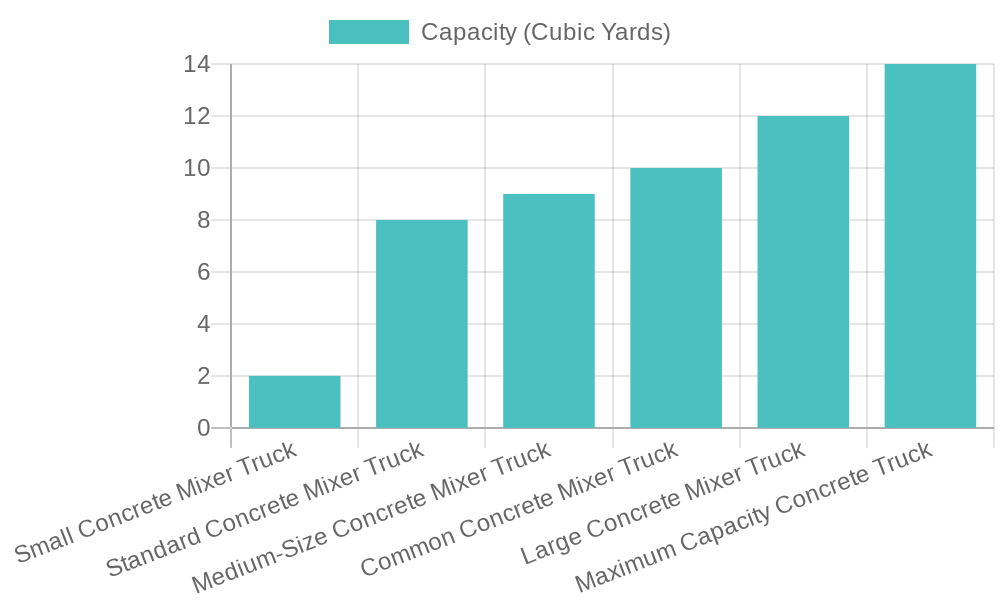
- Small Concrete Mixer Truck: Holds approximately 2 cubic yards of concrete. Ideal for smaller jobs where concrete needs are minimal.
- Standard Concrete Mixer Truck: Typically carries 8 cubic yards. This size is commonly used for residential projects.
- Medium-Size Concrete Mixer Truck: Has a capacity of about 9 cubic yards and is suitable for both residential and small commercial projects.
- Common Concrete Mixer Truck: A versatile size that can hold around 10 cubic yards, often utilized in larger residential or small commercial jobs.
- Large Concrete Mixer Truck: Designed to carry up to 12 cubic yards, catering to more extensive construction needs.
- Maximum Capacity Concrete Truck: These trucks can carry up to 14 cubic yards, making them ideal for significant commercial projects.
Concrete truck capacities generally fall between 2 to 14 cubic yards, depending on the truck’s size and the specific requirements of the task at hand. For more details on truck accessories and enhancements, you might check out various accessories for concrete trucks.
Below is a bar graph that illustrates the capacities of different concrete truck sizes for a better visual understanding.
| Capacity (Cubic Yards) | Capacity (Cubic Meters) | Typical Weight Limit (kg) | Common Uses | Additional Specifications |
|---|---|---|---|---|
| 2 | 1.5 | ~4,500 | Small residential projects, driveways, footings | Compact design, often used in urban areas with limited access |
| 3 | 2.3 | ~6,800 | Minor repairs, patios, small foundations | Light-duty chassis, suitable for tight spaces |
| 4 | 3.1 | ~9,000 | Mid-sized residential and light commercial jobs | Standard configuration for many local contractors |
| 5 | 3.8 | ~11,300 | Medium commercial projects, sidewalks, garage slabs | Increased durability, longer mixer drum |
| 6 | 4.6 | ~13,600 | General construction, warehouse floors, larger driveways | Often uses medium-duty truck chassis |
| 7 | 5.3 | ~15,900 | Large residential, school or office building foundations | Higher capacity mixer drum, improved concrete retention |
| 8 | 6.1 | ~18,100 | Commercial construction, parking structures | Typically equipped with a 10m³ drum; common in major infrastructure |
| 9 | 6.9 | ~20,400 | Industrial facilities, bridge abutments, heavy-duty foundations | High-end models with reinforced suspension and powerful engine |
| 10 | 7.6 | ~22,700 | Major infrastructure projects, highways, large-scale developments | Most common size in ready-mix industry; often paired with 12m³ or 16m³ drums |
Factors Affecting Concrete Load
When considering how much concrete a truck can carry, various factors play a significant role:
1. Regulations
In the United States, the Federal Highway Administration establishes weight limits for concrete mixer trucks. The average gross vehicle weight limit is around 80,000 pounds (36,287 kg). However, these limits vary by state due to local regulations, and they also depend on axle configurations and road restrictions. For instance, most 4×2 concrete mixers have maximum loaded weights between 30,000 to 40,000 pounds (13,608 to 18,144 kg). Similarly, in China, the standard gross vehicle weight limit can reach 25,000 kg (55,116 lbs), depending on specific truck models. Understanding and adhering to these weight regulations is essential for compliance and road safety (source), (source).
2. Types of Concrete
The type of concrete also affects how much can be loaded. For example, ready-mix concrete typically weighs about 145 pounds per cubic foot, while other forms, like lightweight concrete, may weigh less, affecting total loadability.
3. Truck Design
The design of the concrete truck has a major influence on its load capacity. A truck’s structural integrity, the number of axles, and weight distribution are crucial. Mixer trucks configured with additional axles generally have higher weight limits due to better weight distribution (learn more about truck accessories).
Load Capacity Chart
| Region | Maximum Total Weight (lbs) | Standard Payload Capacity (tons) |
|---|---|---|
| United States (e.g., Michigan) | 164000 | ~20 |
| China | ~55116 | ~10-15 |
| European Union (EU) | ~88185 | ~15-20 |
Understanding these factors can help business owners make better decisions on fleet management and ensure compliance during operations. In this way, they can optimize their delivery times and maintain safety on the roads, providing reliable service to their customers.
The Importance of Concrete Trucks in Construction
Concrete trucks play a vital role in the construction industry, particularly when it comes to delivering large amounts of concrete to job sites. Typically, a standard concrete truck can carry about 8 to 12 cubic yards of concrete, depending on the truck’s size and local regulations. This efficient transport method allows contractors to ensure a continuous supply of concrete for their projects, helping to avoid delays and optimize workflow.
Knowing how much concrete a truck can hold is crucial for business owners in planning and budgeting projects effectively. As additional information, certain models may be tailored for specific types of projects, so it’s important to choose the right truck suited to the job at hand.
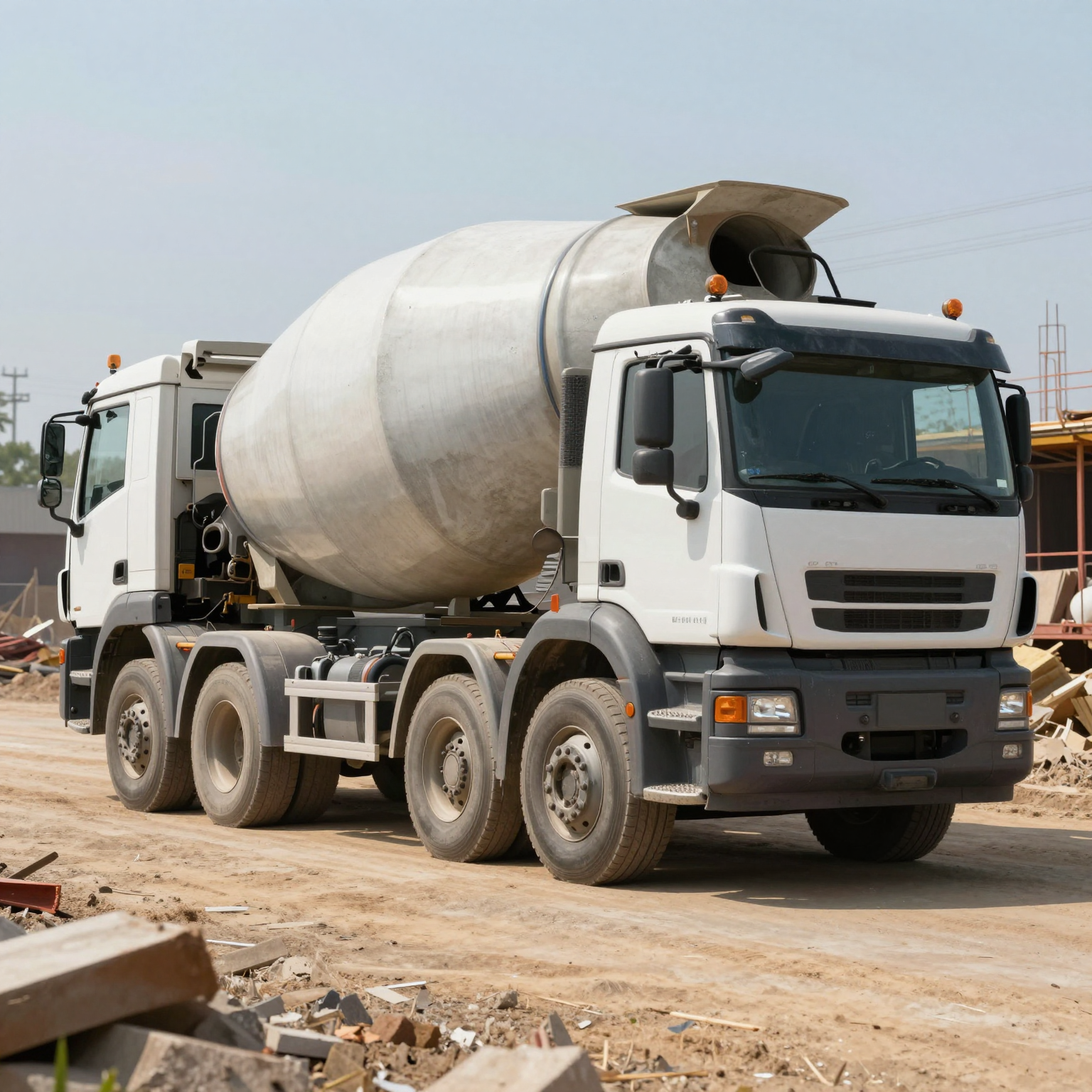
Visual representation of a concrete truck in a construction setting.
To read more about different types of trucks used in construction, check out our truck accessories blog or explore various truck models.
Estimating Concrete Needs for Your Project
Estimating the amount of concrete needed for a project is crucial for business owners to avoid costly mistakes and ensure efficient budgeting. The primary factors to consider when calculating concrete needs are the size of the area you intend to cover and the thickness of the concrete layer required.
Key Considerations
- Area Size: Measure the length and width of the area where the concrete will be poured. This is often measured in square feet. For rectangular areas, simply multiply the length by the width. For round areas, use the formula for the area of a circle: [ \text{Area} = \pi r^2 ] where r is the radius.
- Thickness: The thickness of the concrete layer also affects the total volume required. Most concrete installations recommend a thickness of 4 inches for slabs, though this may vary depending on structural requirements.
- Waste Factor: It’s prudent to add a waste factor of 10% to your total volume calculations. This accounts for spills, over-excavation, and variations in site conditions.
Calculation Method
The formula to calculate the volume of concrete needed is:
[ \text{Volume (cubic yards)} = \frac{\text{Area (sq ft)} \times \text{Thickness (inches)}}{324} ]
For example, if you are pouring a concrete patio that is 10 ft by 10 ft with a thickness of 4 inches, the calculation would be:
[ \text{Volume} = \frac{(10 \times 10) \times 4}{324} = 1.23 \text{ cubic yards} ]
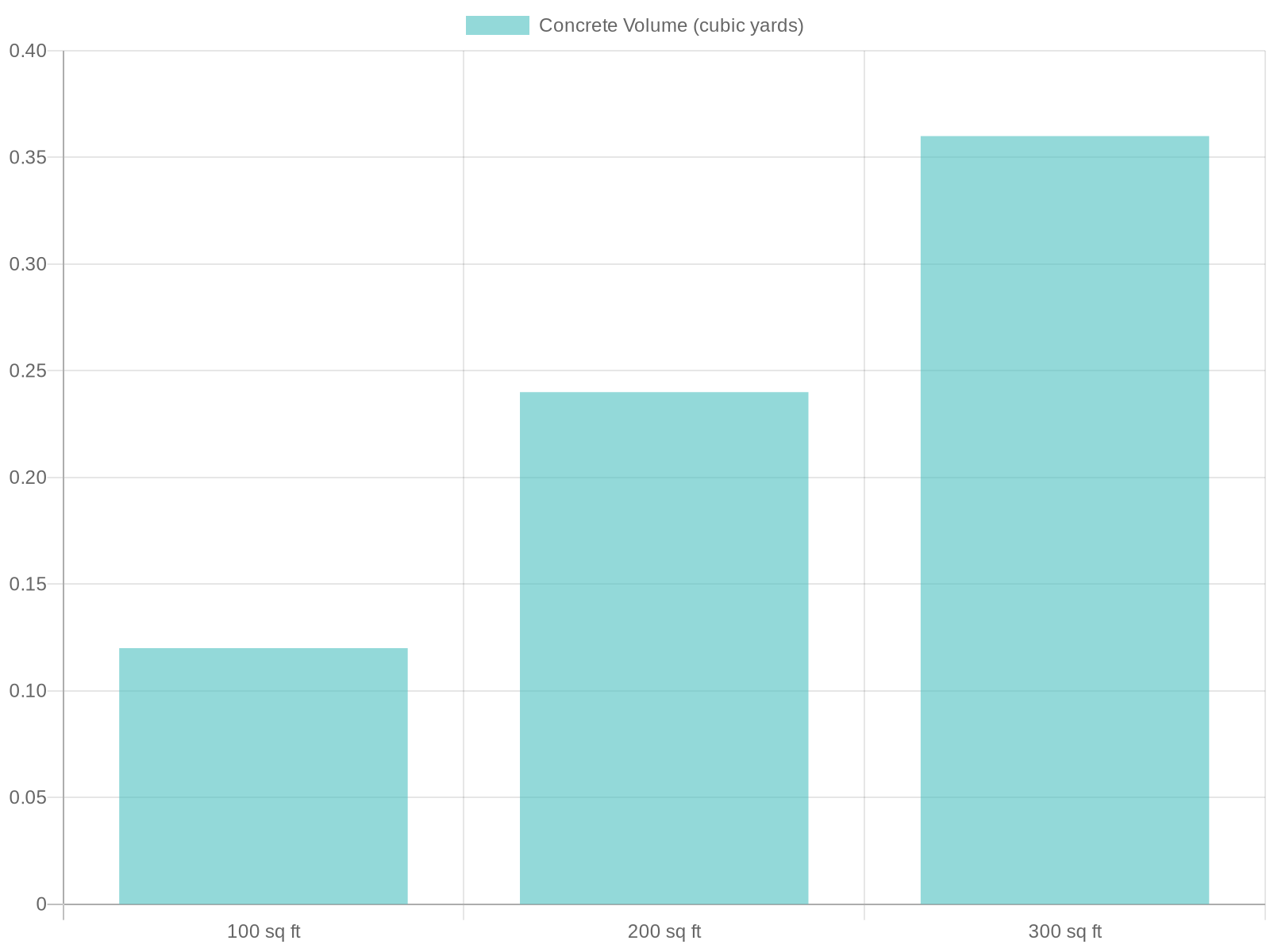
To visualize how different project sizes impact the volume of concrete needed, refer to the chart below that displays cubic yards required for varying project sizes (assuming a 4-inch thickness including a waste factor).
Final Thoughts
By using the area size, thickness, and adding a waste factor, you can accurately estimate the amount of concrete required for your project. For a detailed step-by-step guide or additional resources, consider exploring more on calculating concrete volumes here or tools and accessories for concrete projects here.
Calculating the concrete yield is essential for ensuring that you order the right amount of concrete for your project. Understanding how to calculate concrete yield involves knowing the weight of the concrete delivered, the density of the mix, and the specific project requirements. Here’s a breakdown of how to calculate concrete yield based on truck loads:
- Concrete Truck Capacity: This usually ranges from 20,000 to 30,000 pounds depending on the truck type and regional specifications.
- Concrete Density: Standard concrete density is about 150 pounds per cubic foot, but this can vary based on aggregate and water-cement ratio.
- Net Truck Weight: The weight of the truck itself is typically between 25,000 and 35,000 pounds.
- Total Concrete Weight: Measure the total weight of the concrete at the unloading site, subtracting the net truck weight to find the actual weight delivered.
- Volume Calculation (Cubic Feet): Use the formula:
Concrete Volume = Total Concrete Weight / Concrete Density. - Volume Conversion (Cubic Yards): Convert cubic feet to cubic yards by dividing by 27 (as there are 27 cubic feet in a cubic yard).
- Required Concrete Volume: Determine based on project drawings or plans.
- Comparison of Delivered vs. Required: Calculate the difference:
Delivered Amount - Project Requirementsto assess efficiency or potential waste.
For a visual representation of the concrete yield calculations, see the chart below!
Real-Life Case Study Example
Consider the case of a contractor named Alex who was preparing for a large commercial construction project involving the pouring of several concrete foundations. Alex knew that accurate calculations were essential to prevent both waste and budget overruns.
To determine the exact amount of concrete needed, Alex began by thoroughly measuring each section of the foundation and converting these measurements into cubic yards. He referenced the standard concrete truck capacity, which typically ranges from 8 to 10 cubic yards. After calculating the total volume of concrete required for the project, Alex ordered the necessary number of truckloads, ensuring they arrived on schedule. This precise calculation not only kept the project within budget but also minimized the material waste, highlighting the critical need for accurate concrete estimations in large projects.
For additional insights on how to manage construction resources effectively, check out this article on truck accessories.
Summary
In conclusion, understanding the capacities of concrete trucks is essential for effective project management and successful business operations. Knowledge of how many yards of concrete a truck can hold-typically ranging from 6 to 12 cubic yards-helps business owners make informed decisions when planning construction projects.
Here are some key points to consider:
- Capacity Varieties: Concrete trucks commonly hold between 6 to 12 cubic yards. It’s vital to select the right truck capacity according to project needs to maximize efficiency.
- Cost Efficiency: Properly sized trucks avert unnecessary expenses related to fuel and maintenance while ensuring timely deliveries. Overusing or underusing truck capacities can lead to operational inefficiencies and poor project management.
- Quality Control: Adequate knowledge of truck capacities also ensures better control over the quality of concrete delivered to projects, which is crucial for maintaining work standards.
- Regulatory Compliance: It helps in avoiding legal issues associated with overloading and ensures compliance with transportation regulations.
In summary, by recognizing the capacities of concrete trucks and their implications on delivery efficiency and cost-effectiveness, business owners can enhance their operational strategies, minimize waste, and foster a more profitable working environment. For additional insights on construction accessories to aid your projects, check out our accessories blog or our guide on how to pick the right vehicle for your needs through Vantech’s solutions.
Call to Action for Pizza Truck Solutions
Are you ready to elevate your food business with a unique and mouth-watering offering? At Truck Pizza, we specialize in providing tailored pizza truck solutions to meet your specific business needs. Whether it’s a fully equipped mobile pizza kitchen or a custom-designed food truck, our options can help you attract customers and stand out in a competitive market. Don’t miss the opportunity to enhance your food service with a mobile pizza truck that’s designed for efficiency and quality.
Explore all the possibilities and see how we can guide you on this delicious journey by visiting Truck Pizza today!